The Most Profitable Body Builder in 2030 Builds Nothing
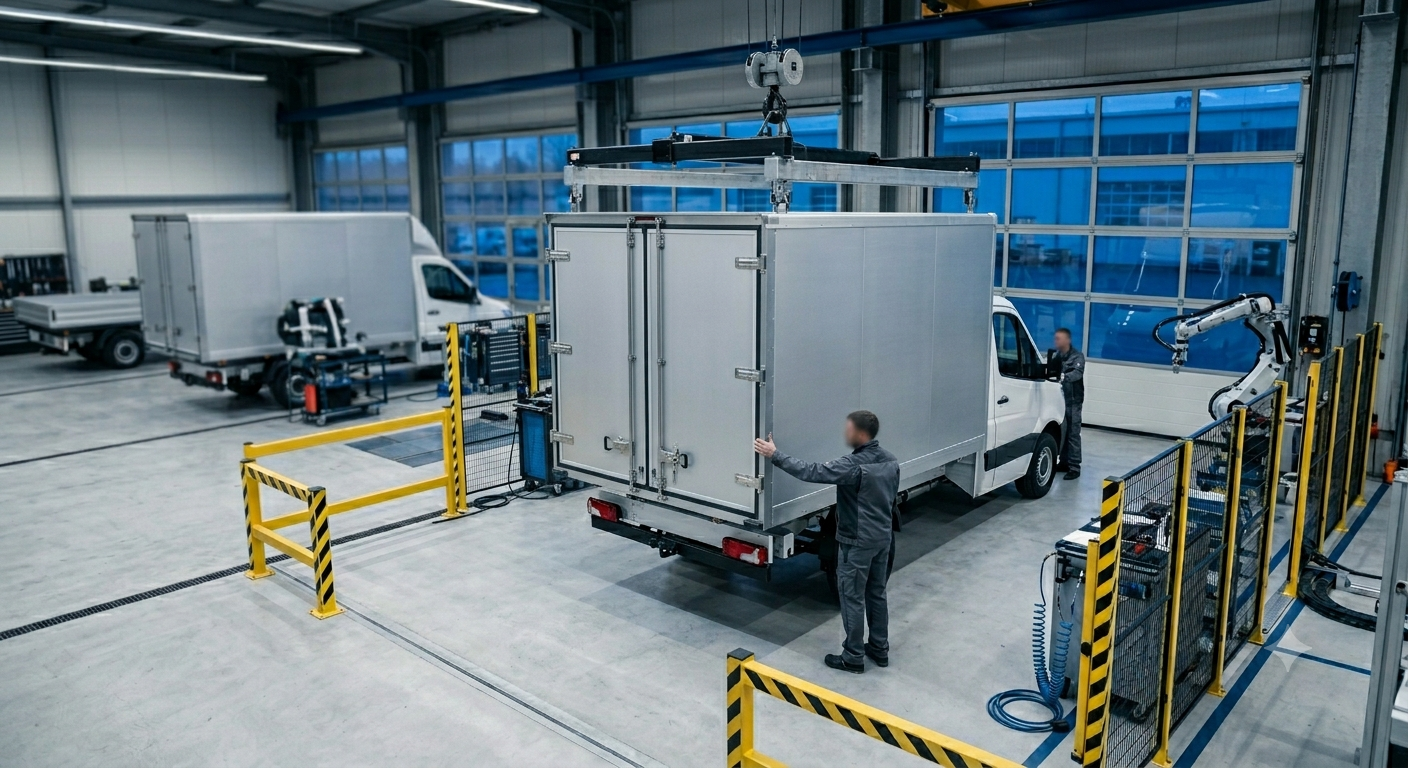
By 2030 the most profitable body builders will not fabricate — they will integrate. The cost-structure math behind the shift from welding hours to assembly capacity, and the smart 70/30 split.
Here is an uncomfortable prediction: by 2030, the most profitable body builders in Europe will not fabricate bodies at all. They will integrate them. And the workshops still cutting, welding and painting every body from raw steel will be wondering where their margin went.
The math that is killing the old model
The traditional body builder's cost structure is a product of a labour market that no longer exists. Manufacturing wages across the EU have risen year after year, and skilled welders are the hardest people to hire in the entire industry — when a fabricator retires, his replacement often simply does not exist. Meanwhile every body built from scratch carries its own engineering risk: rework, certification effort, inconsistent quality between unit one and unit twenty.
Look at the same workshop running an "integrate and deliver" model with pre-engineered kits: fabrication disappears from the cost structure entirely. Purchasing becomes the biggest line — but it buys a finished, repeatable, documented product. Assembly hours are predictable. Documentation comes with the kit. Margin per body roughly doubles in our illustrative model, and — this is the part that matters — output per employee can triple, because assembly is a skill you can hire and train in weeks, not years.
"But we are craftsmen"
The objection is real and deserves a straight answer. Craft still wins on genuinely custom work: rescue platforms with special equipment, complex municipal builds, one-off engineering. That work is profitable precisely because it is rare. The problem is applying craft economics to standard products — a 4.2 m dropside, a classic curtain side, a 3-way tipper on a Daily. Those are commodities with known geometry, and building commodities by hand is how workshops go broke slowly.
The smart split we see emerging across Europe: standard bodies from kits, craft capacity reserved for the custom work that actually pays for it. The kit handles 70% of volume; your best people handle the 30% where their skill is irreplaceable.
What the dealers already know
LCV dealers spotted this first, because they live on turnaround time. A dealer who can deliver a tipper two weeks after chassis arrival — instead of two months in a body builder's queue — wins the fleet deal. Pre-engineered kits, fitted by the dealer's own workshop or a local partner, are how that two-week promise becomes possible.
Where this leaves you
The 2030 question is not "can we build a body?" — of course you can. It is "what does each hour of our workshop earn?" If the answer on standard bodies is less than what an assembly-based model would earn, the transition is not a threat. It is the raise your workshop has been waiting for.
Your manufacturing partner from 2025
Kit-Go builds the bodies.You build the business.
350+ pre-engineered aluminium and steel body kits — CKD to fully assembled, EU production, full component traceability, and transparent volume pricing. Your workshop sells installation capacity; Kit-Go handles manufacturing complexity.
350+
Body kit models
1 shift
CKD first build
EU
Production & traceability
Browse all body kits →
Request a B2B quote