EVs Are Changing the Real Business Model of Commercial Vehicle Dealers — Are Service Revenues at Risk?
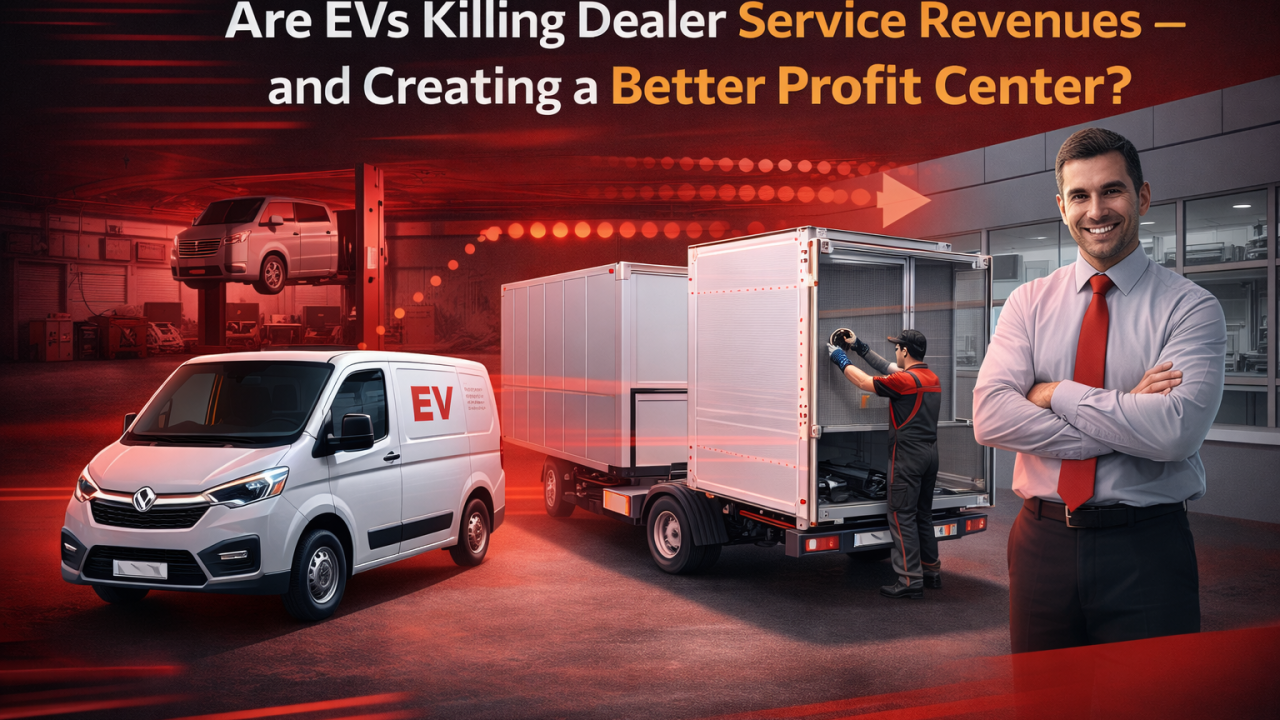
Electric commercial vehicles require 30–50% less maintenance than diesel. What happens to dealer aftersales revenue — and could body installation become the new profit center for commercial vehicle dealerships?
For decades, the commercial vehicle business followed a predictable rule: sell the vehicle once, earn from service for years. But electrification is quietly breaking this model — and many dealers are not yet talking about it openly.
⚡ 1. The EV Reality Nobody Likes to Discuss
Electric commercial vehicles are fundamentally different from ICE vehicles. They have fewer moving parts, no oil systems, no exhaust systems, no complex transmission servicing, and significantly reduced mechanical wear.
Multiple fleet operator studies and industry analyses — including data from ACEA and independent fleet benchmarks — indicate that EV maintenance costs can be 30–50% lower compared to diesel equivalents. Which sounds great for fleets — but raises a serious question:
What happens to dealer aftersales revenue?
🔧 2. Service Departments Built for ICE Economics
For years, dealer profitability relied heavily on periodic servicing, mechanical repairs, component replacement, and long-term maintenance contracts. ICE vehicles created recurring workshop activity.
EVs reduce exactly those activities. Less maintenance means fewer workshop hours, lower parts turnover, and reduced service margins. The traditional profit engine starts slowing down.
💼 3. Dealers Need a New Profit Center — Fast
Here is where the structural shift becomes interesting. Commercial vehicle dealers already have: workshops and trained technicians, lifting equipment and diagnostic tools, logistics capability and customer relationships, and chassis sales volume.
In other words: they already possess almost everything needed for another activity — without new investment.
🚛 4. The Untapped Opportunity: Body Installation as a Dealer Profit Center
Every chassis sold eventually needs a body. Today, many dealers sell the chassis, send the vehicle to an external bodybuilder, wait weeks for completion, and transfer part of the profit outside their own company.
Modern modular body kits change the equation: compact delivery, fast installation (often within one working shift), predictable assembly processes, minimal fabrication required, and no heavy manufacturing investment. This allows dealers to transform their own service departments into vehicle completion centers.
📊 5. Replacing Lost ICE Revenue — Without Major Investment
Instead of declining workshop activity, dealers could generate revenue through body installation labor, faster vehicle delivery, higher margin per unit sold, improved customer retention, and better cash flow rotation.
And most importantly: profit stays inside the dealership — not transferred to external converters.
🔄 6. A Structural Industry Shift
As EV adoption grows, dealerships may evolve from service-driven businesses into vehicle solution integrators. The dealer becomes the final step in the value chain — delivering ready-to-work vehicles tailored to immediate customer needs. Not months later. But days later.
The Real Question for the Industry
Are commercial vehicle dealers prepared for a future where service revenue decreases — but vehicle completion becomes the new margin engine? Or will independent bodybuilders remain the default solution?
I'd genuinely like to hear perspectives from commercial vehicle dealers, OEM representatives, leasing companies, bodybuilders, and fleet operators. Do you see workshops losing activity with EV adoption? Could in-house body installation become a natural evolution for dealers?
Let's discuss openly — because this shift may redefine dealership profitability over the next decade.
Explore Kit-Go Body Solutions
- Discover compatible body kits on Kit-Go.com — modular kits designed for fast dealer installation
- Explore the technical fitment selector — find the right body for any chassis in minutes
- Request a quote for your project — CKD, PAS and FAS kits available